
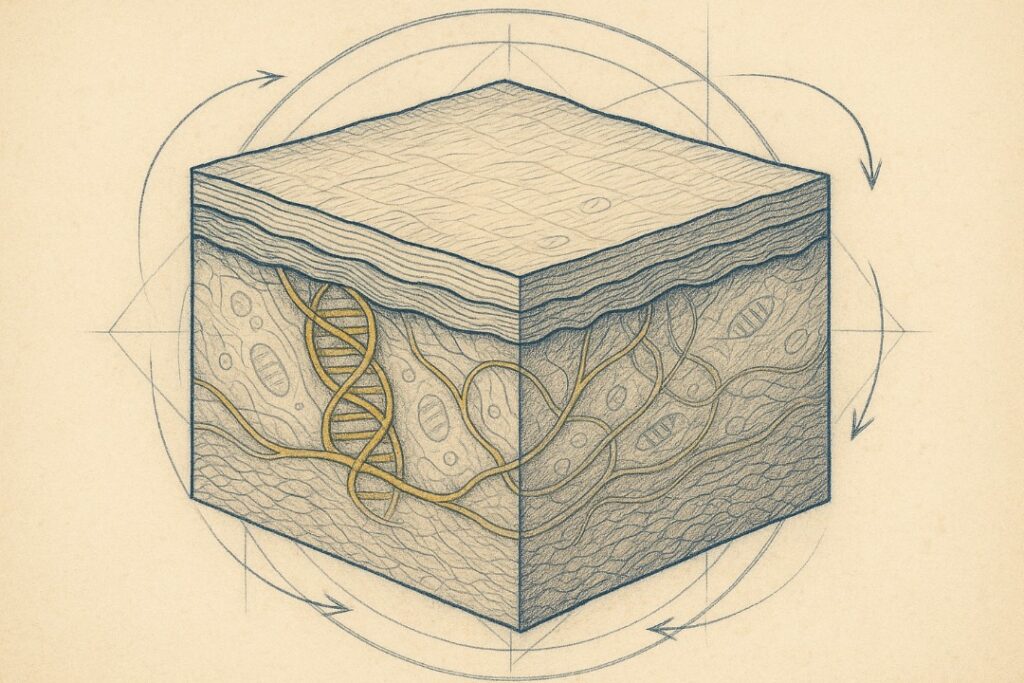

Skin can sometimes be dismissed as cosmetic—a surface to smooth, polish, or preserve. But modern biology tells a different story: skin is both a mirror of aging and an active player in how we age. Earlier this year, a landmark peer-reviewed review in Nature Aging synthesized two decades of research showing that skin not only reflects the passage of time but also actively influences how the rest of the body ages. Furman and colleagues describe skin as a “unique window into our overall health and the biological aging process.”
All 12 hallmarks of aging—the cellular and molecular shifts that define biological decline—are visible through the skin. The thinning epidermis, the loosening of collagen, the muted response of immune patrol cells: these are not just surface changes. They are systemic biology made visible. Seen this way, skin becomes more than just appearance. It is a biological sentinel, recording every exposure while broadcasting the pace of cellular renewal and repair beneath. Because skin is a two-way organ, what happens on its surface can ripple inward—influencing inflammation, bone strength, and cognition.
Skin is not a veneer; it is the interface between our inner biology and the outside world. Researchers describe two interwoven paths of aging:
- Intrinsic aging: The steady ticking of internal clocks. Telomeres shorten like the fraying tips of shoelaces, mitochondria falter, and stem cells become exhausted.
- Extrinsic aging: The cumulative wear of exposure. Ultraviolet light unravels collagen, pollution adds oxidative stress, and lifestyle choices accelerate decline.
Togther, these forces reshape the dermis: collagen fibers lose their scaffolding, pigment regulation slows, immune defenses weaken, and the barrier thins. Skin becomes both a record and a witness—a diary etched with time and exposure.mis: collagen fibers lose their scaffolding, pigment regulation slows, immune defenses weaken, and the barrier thins. Skin becomes both record and witness — a diary etched with time and exposure.

How Coordinated Are Your Core Biological Systems?
Take the Nurture Assessment to evaluate systemic load across gut, redox, collagen and energy pathways.
The Hallmarks of Aging Seen Through Skin
The Nature Aging review shows all twelve hallmarks manifest in skin biology. Here are four with the clearest signatures.
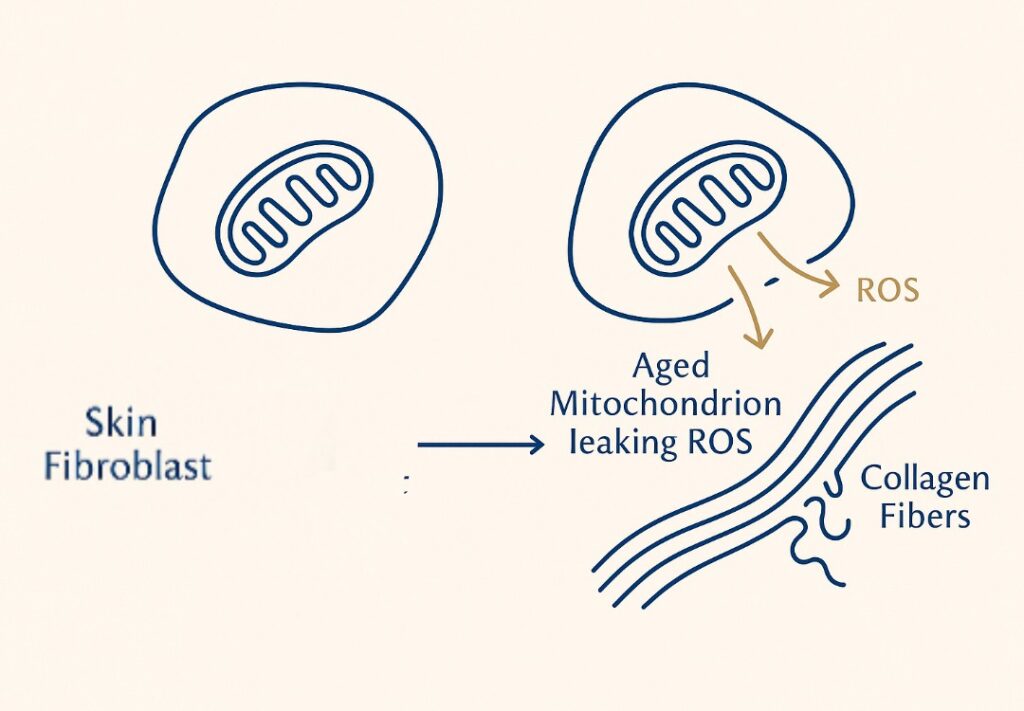
Mitochondrial Dysfunction: The Dimming of Cellular Batteries
Mitochondria are the cell’s batteries, generating energy as ATP. With age, they produce less and leak unstable by-products called reactive oxygen species (ROS) — molecules that damage DNA, proteins, and lipids. In skin, this means slower healing, weaker collagen, and lost elasticity — like a city whose power grid flickers and fails.
Cellular Senescence: The Zombie Cells That Linger
Cells have natural lifespans. When they accumulate too much damage, many will enter senescence — a state where they permanently stop dividing but don’t die. These “zombie cells” linger in the skin, releasing inflammatory signals and tissue-degrading enzymes, a pattern called the senescence-associated secretory phenotype (SASP). Instead of supporting renewal, they actively disrupt their neighbourhood.
In skin, senescence drives chronic low-grade inflammation, collagen breakdown, and thinning. Together these processes accelerate tissue aging.
Loss of Proteostasis: Collagen’s Fragile Web
Proteostasis is balance: making new proteins and repairing old ones. With age, this system falters. Damaged proteins pile up, collagen production slows, and the extracellular matrix unravels. Like ropes in a suspension bridge left unrepaired, the skin sags under its own weight.
The result: wrinkles, sagging, and reduced resilience.
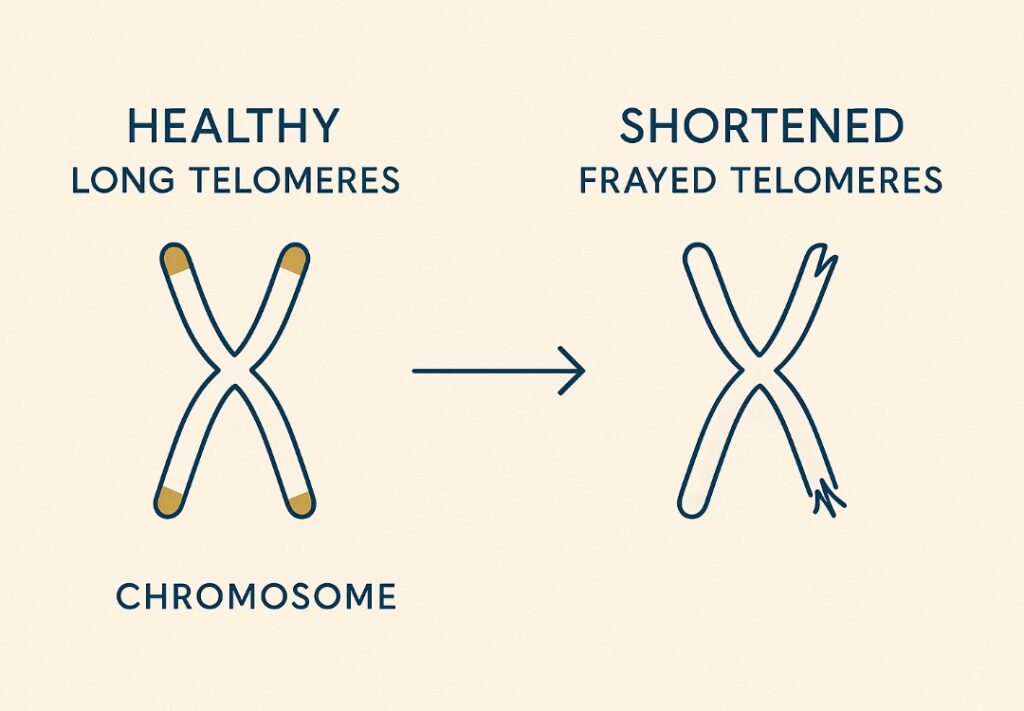
Telomere Attrition: The Fraying of the Cellular Clock
Telomeres are protective caps of DNA at chromosome ends. Each cell division shortens them, ticking down the number of safe replications. When too short, cells either enter senescence (zombie state) or self-destruct.
Either way, the tissue loses its supply of fresh, regenerative cells — one reason why aging skin becomes thinner, slower to repair, and more vulnerable.
Together: A Visible Biology of Time
These hallmarks don’t act alone. Mitochondrial dysfunction fuels senescence; senescent cells amplify inflammation; loss of proteostasis weakens collagen; telomere attrition limits repair.
What we see in the mirror is not superficial — skin records the interplay of these cellular shifts, making aging tangible in every line and change of texture.
Skin’s Ripple Effect on the Whole Body
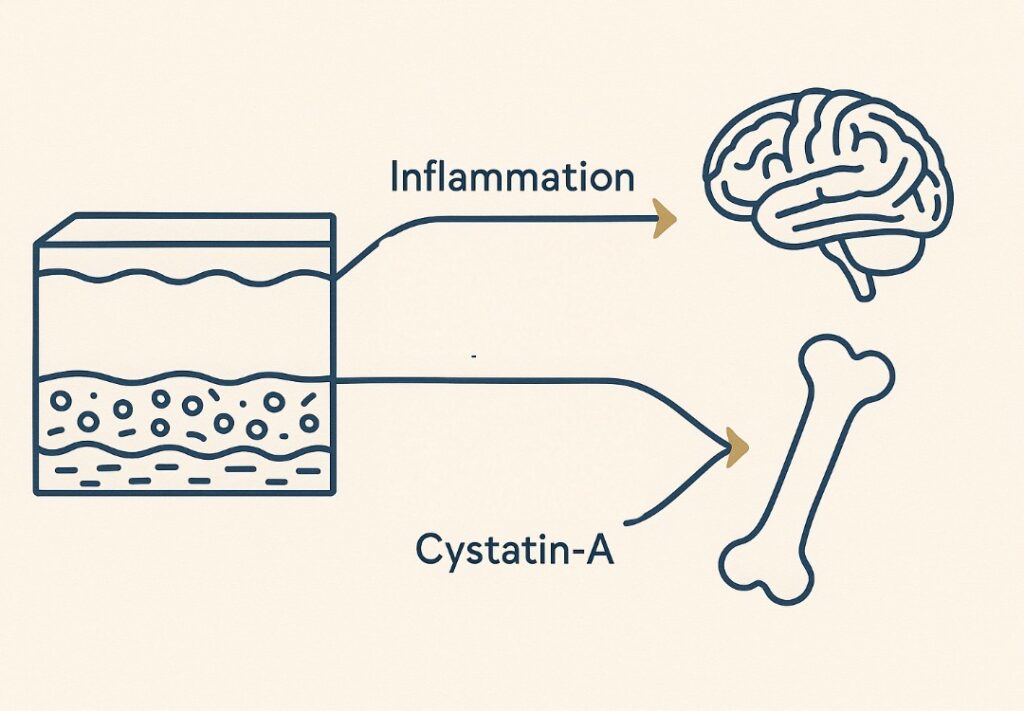
The 2025 Nature Aging review makes a subtle but profound shift: skin is not only a marker of aging, it is also a mediator. What happens on the surface doesn’t stay there — it sends ripples inward, influencing the biology of the entire body.
Inflammaging
Senescent cells in the epidermis and dermis secrete pro-inflammatory molecules. Normally, these signals are useful in short bursts — calling for repair after injury. But when they persist, they spill into circulation, feeding a state known as inflammaging.
This systemic fire accelerates aging in distant organs. It is linked to frailty, metabolic disease, and cardiovascular decline. This is one way local skin changes ripple into the body’s systemic health.
Bone Health
One of the review’s most striking findings is the connection between aging skin and bone fragility. Chronologically aged skin increases secretion of a protein called cystatin-A. Elevated cystatin-A disrupts bone maintenance, contributing to osteoporosis.
This means that the loss of skin resilience is not just cosmetic — it may actively weaken skeletal strength.
Cognition
Surprisingly, skin interventions can affect brain health. The review cites evidence that topical emollients — simple moisturizers — reduced progression of cognitive impairment in elderly individuals. The mechanism isn’t fully understood, but it highlights evidence that show: maintaining skin barrier integrity reduces systemic inflammation and improves immune regulation, which in turn supports brain resilience.
Gut–Skin Axis
Skin and gut communicate through immunity. Wounds or inflammation in skin alter gut microbes; when skin is persistently inflamed, those danger signals don’t stay local — they circulate and can shift immune tone and microbial balance in the gut. Conversely, gut dysbiosis reflects back on skin as more inflammation, slower repair, and a weaker barrier.
Big picture: skin health reverberates through the body, shaping bones, brain, and immunity.
5. Emerging Interventions (But Handle with Care)
If skin mirrors and mediates systemic aging, interventions may ripple beyond appearance. The review highlights lifestyle, systemic, and topical avenues — most experimental, some risky.
NAD⁺ Boosters: Recharging Energy
Research: NAD⁺ powers mitochondrial repair and declines with age. Restoring it in skin models improved energy balance and repair.
Context: Outside this paper, NMN and NR supplements raise NAD⁺ in humans, though studies in NMN are still in early stages, and vitamin B3 remains the safest long-established option. But their impact on skin aging specifically has not been proven. [Trammell 2016; Martens 2019]
Mitochondrial Medicines: Protecting the Batteries
Research: Urolithin A (UA) promoted mitophagy—recycling of defective mitochondria—in human skin cells, protecting against UV damage. This was achieved in human dermal fibroblast cell cultures, not human clinical trials.
Context: Outside this paper, UA has human clinical trial evidence for muscle endurance, but no skin-focused human studies yet.[Liu et al., 2022]
Autophagy Inducers: Cellular Housekeeping
Research: Compounds like spermidine and curcumin enhanced recycling and senescence control in skin lab models. Their skin relevance remains early-stage.
Context: Spermidine has small human studies suggesting benefits for healthy aging and cognition, but trials are early. Curcumin has broader human evidence for inflammation and joint health; its role in skin aging is still emerging.[Daily JW et al., Crit Rev Food Sci Nutr, 2017]
Topical Strategies: More Than Skin-Deep
Research: Antioxidants (phenolics, lycopene, green tea catechins) protected against UV damage. Emollients strengthened barriers and even slowed cognitive decline in elderly patients.
Early or Prescription-Only Interventions
The review also mentions senolytics, topical rapamycin, and telomerase modulation. These remain prescription-only or experimental, with potential risks alongside promise.
Putting it together: future strategies will need to be multi-targeted, addressing energy, repair, inflammation, and barrier integrity in tandem.
Biomarkers: From Speedometers to Dashboards
Most current skin biomarkers track one signal — useful, but narrow, like judging a city’s traffic by a single light. The review points toward multi-signal “dashboards” that combine gene activity, proteins, and metabolites for a truer picture of skin biological age.
A first generation of such tools used DNA methylation — tiny chemical tags on DNA that act like dimmer switches for genes. By reading patterns across many tags, researchers can estimate biological age more precisely than with a single marker. These advanced clocks are largely research- or clinic-grade. Consumer tests that promise a single number should be interpreted cautiously until multi-signal approaches mature.
Key Takeways
Skin science is advancing rapidly. Researchers are uncovering how the skin doesn’t just reflect aging but actively influences how the rest of the body ages. That makes it one of the most exciting frontiers in healthspan.
Current tests are blunt: most measure one signal, like judging all of London’s traffic by one light. The future lies in dashboards — multi-signal readouts combining gene activity, protein shifts, and metabolism.
For now, your takeaways are simple:
- Be curious, but cautious. Many therapies are promising but unproven for skin. Don’t be swayed by buzzwords; look for interventions backed by long-term human studies.
- Never overlook the fundamentals. The strongest, safest allies are already proven: protect your barrier, limit UV, eat a nutrient-rich diet, and reduce inflammation. These basics, backed by decades of research, remain your strongest allies while science explores the future.
Skin is both lens and lever — reflecting inner biology while offering practical ways to nurture resilience today.
Be first to try our evidence-built formulations.
Collagen Cofactor Complex + Cellular Triad Glutathione Complex.
No noise. No guesswork. Just biologically honest design.