
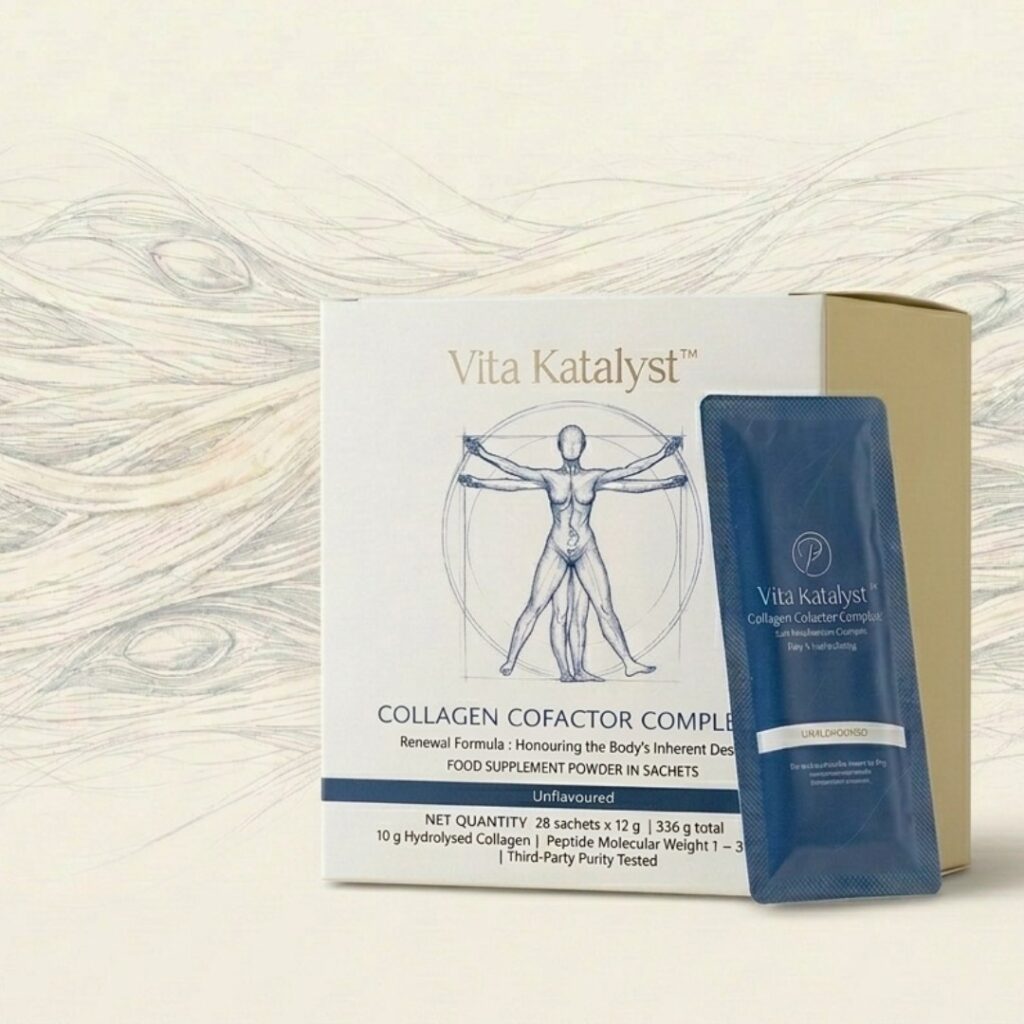
Collagen Cofactor Complex™:
The Blueprint of Renewal
A multi-pathway methodology for structural integrity
Structural Substrate
10,000 mg Hydrolysed Collagen Peptides
Provides bioavailable collagen peptides
Enzymatic Activation
300mg Vitamin C
Enables hydroxylation, the process that allows collagen to stabilise and form properly
Mineral Architecture
10:1 Zinc-Copper Equilibrium
Supports cross-linking, the process that binds collagen fibres together for strength.
Matrix Stabilisation
10 mg Silicon (Living Silica™)
Supports structural organisation of collagen fibres
Cellular Regulation
450 μg Biotin
Contributes to cellular turnover and keratin infrastructure.
Structural Substrate
10,000 mg Hydrolyzed Bovine Collagen Peptides (COLLinstant®)
We use clinically studied COLLinstant® hydrolyzed collagen peptides.
These peptides provide concentrated glycine, proline, and hydroxyproline, the dominant amino acids in dermal collagen. Beyond serving as structural raw material, collagen peptides also function as biological signals, with circulating dipeptides such as Pro-Hyp and Hyp-Gly stimulating fibroblasts to support the body’s own collagen and hyaluronic acid production.
Ten grams is not symbolic. It reflects the upper dose range used in clinical studies examining skin density, elasticity, and dermal structure.
Read more about COLLinstant®Hydrolysed Bovine Collagen Peptides.
Enzymatic Activation
300 mg Vitamin C
Collagen requires hydroxylation (a stabilisation step) before it can form a functional structure.
Without sufficient Vitamin C, newly formed collagen lacks strength and integrity.
The body can only absorb a limited amount Vitamin C at once. Plasma levels approach saturation between 200–400 mg, as SVCT1 transport reaches capacity.
At 300 mg, this dose aligns with that physiological window; supporting effective collagen stabilisation without excess.
Mineral Architecture
10 mg Zinc | 1 mg Copper
Collagen integrity depends on more than synthesis.
Zinc supports protein production and regulates matrix turnover, including enzymes (MMPs) that control collagen breakdown during stress and inflammation.
Copper activates lysyl oxidase, the enzyme that enables cross-linking of collagen fibres for strength and stability.
The 10:1 ratio reflects how these minerals function together. Because zinc and copper compete for absorption, maintaining balance supports connective tissue structure without disrupting mineral equilibrium.
Matrix Stabilization
10 mg Silicon (from Living Silica™ Acacia Gum-OSA)
Silicon supports the organisation of collagen fibres within the extracellular matrix (ECM).
Orally ingested hyaluronic acid is fragmented during digestion and largely utilised by the gut lining, immune system, and joint tissues, meaning only a limited amount reaches the skin. Silicon supports the fibroblast driven production of glycosaminoglycans (GAGs), including hyaluronic acid.
Plant-derived silica sources such as bamboo which exist in rigid, insoluble forms that are poorly absorbed, whereas OSA remains soluble and available for connective tissue metabolism.
Read more about Living Silica™ and Silicuim Laboratories.
Radical Transparency
Every batch is independently tested for heavy metals and microbiological contamination in ISO 17025 accredited laboratories.
We disclose exact dosages, named raw material sources, and third-party testing.
All Certificates of Analysis (COAs) are available online through the Transparency Hub.
Precision without proof is marketing.
Precision with disclosure is integrity.