Enter your Collagen Cofactor Complex™ unique batch number to access comprehensive third-party lab results, Certificate of Analysis, ensuring purity, and scientific integrity.
A Certificate of Analysis (COA) is a formal laboratory document detailing the chemical composition and safety profile of a specific production batch. When performed by an independent ISO 17025 / ACCREDIA accredited laboratory, it represents one of the highest standards of analytical transparency and quality control within the supplement industry.
While the UK Food Standards Agency (FSA) ensures essential consumer safety, food supplement regulations are designed to provide a baseline framework rather than an exhaustive purity standard. For instance, current UK and EU food laws do not mandate statutory ceilings for total bacterial counts in supplements, and Regulation 2023/915 contains no blanket limits for Arsenic.
Modern refining processes isolate nutrients into uniform powders, they neutralize the natural sensory indicators, taste, smell, and appearance. To complement these statutory baselines and address this sensory gap, Vita Katalyst operates under an elevated testing framework, voluntarily applying testing standards aligned with the European Pharmacopoeia (Ph. Eur.) and ICH Q3D guidelines, frameworks designed for pharmaceutical manufacturing.
Every batch of Collagen Cofactor Complex is tested for heavy metals and a full spectrum of microbial contaminants, prior to release. Testing is performed by Complife Italia, an ISO 17025 / ACCREDIA accredited laboratory.

Lab Info & Certifications
Issued by Complife Italia S.r.l., ISO 17025 accredited (Accreditation No. 00945, ACCREDIA). ISO 17025 is the highest international standard for testing laboratories; the same standard used in pharmaceutical and forensic testing.
Sample & Batch ID
The batch number printed on your packaging should correspond exactly to the batch number shown on this Certificate of Analysis. Each batch is tested individually, and these results apply exclusively to this specific production run traceable to your product.
Heavy Metals Results
Four heavy metals tested using ICP-MS; one of the most sensitive detection methods available. Results marked with “<” indicate the contaminant was below the laboratory’s detectable limit, even at maximum instrument sensitivity.
View industry reference thresholds for food and pharmaceutical standards in this table.
View your batch-specific Certificate of Analysis here.
Lab Authorisation
Signed by Chemical Lab Supervisor. Testing is conducted in compliance with ISO 7218:2024 standard laboratory guidelines. Ready to review your batch specific COA?
Metal |
EU / UK legal limitReg 2023/915 & UK 1881/2006 |
Pharmaceutical standardPh. Eur. ICH Q3D (mg/kg) |
Daily ExposurePharma Oral PDE (µg/day) |
|---|---|---|---|
Lead (Pb) |
3.0 mg/kg | 0.5 mg/kg | 5.0 µg/day |
Cadmium (Cd) |
1.0 mg/kg | 0.5 mg/kg | 5.0 µg/day |
Mercury (Hg) |
0.10 mg/kg | 3.0 mg/kg | 30.0 µg/day |
Arsenic (As) |
No blanket limit * | 1.5 mg/kg | 15.0 µg/day |
*Note: EU 2023/915 does not contain a row for Arsenic in food supplements. The industry uses 3.0 mg/kg (from Regulation 231/2012) as a safety proxy for raw materials.
The standards we hold ourselves to are not the minimums expected of food supplements, but the analytical benchmarks more commonly associated with pharmaceutical-grade testing.

Lab Info & Certifications
Microbial testing follows European Pharmacopoeia (Ph. Eur.); the regulatory standard for pharmaceutical safety in Europe, stricter than standard food supplement requirements.
Sample & Batch ID
The batch number printed on your packaging should correspond exactly to the batch number shown on this Certificate of Analysis. Each batch is tested individually, reflecting the exact product state at manufacture.
Total Microbial Count (TAMC & TYMC)
TAMC measures total bacteria. TYMC measures yeast and mould.
View industry reference thresholds for food and pharmaceutical standards in this table.
View your batch-specific Certificate of Analysis here.
Pathogen Screening
Four pathogens tested: E. coli, Salmonella, Staphylococcus aureus, and bile-tolerant gram-negative bacteria.
View industry reference thresholds for food and pharmaceutical standards in this table.
View your batch-specific Certificate of Analysis here.
Pharmaceutical Standards
Standard food laws don't mandate strict safety limits for most microbials in supplements. We voluntarily test every batch to strict European Pharmaceutical standards (Ph. Eur.) to ensure absolute purity. View your batch specific COA?
Lab Authorisation
Signed by the Microbiology Laboratory Supervisor. Testing is conducted in compliance with ISO 7218:2024 standard laboratory guidelines. Ready to review your batch specific COA?
ParameterScientific Name |
Biological SignificanceAnalytical Context |
EU / UK Food Standard(Reg EC 2073/2005) |
Ph. Eur. 5.1.4 Limit(Oral, Non-Aqueous) |
|---|---|---|---|
TAMC (Total Aerobic Microbial Count) |
Volume of viable aerobic bacteria per gram; acts as a core indicator of raw material sanitation. | No set food limit* | ≤ 1,000 CFU/g |
TYMC (Total Yeast & Mould Count) |
Total fungal, yeast, and mould bioload; tracks environmental moisture and storage control. | No set food limit* | ≤ 100 CFU/g |
Escherichia coli |
Direct indicator of fecal contamination and severe processing hygiene breakdown. | No set food limit* | Absent in 1g |
Salmonella spp. |
High-risk, dangerous foodborne pathogen responsible for severe gastrointestinal infection. | Absent in 25g | Absent in 10g |
Staphylococcus aureus |
Toxin-producing pathogen linked to skin, respiratory, and cross-contamination from handling. | No set food limit* | Absent in 1g |
Bile-Tolerant Gram-Negative Bacteria |
Broad class of environmental contaminants resistant to bile salts; tests resilience against sanitation protocols. | No set food limit* | ≤ 100 CFU/g |
At Vita Katalyst, we believe our relationship with you is a partnership built on trust. Our commitment is a system of three pillars, meticulously engineered for complete clarity: our “Trinity of Proof” – Explore Our Collagen Cofactor Formulation

We align with what evidence has established
Every dosage reflects peer-reviewed studies, never marketing trends.
So you can trust results grounded in research integrity.

We never assume purity, we verify it.
Every ingredient is subjected to rigorous third-party testing for heavy metals and contaminants.
So you receive formulations as clean as they are effective.

We disclose everything, without exception.
Every active ingredient and dosage is listed in full, no blends, no omissions.
So you can make intelligent, conscious choices with complete clarity.
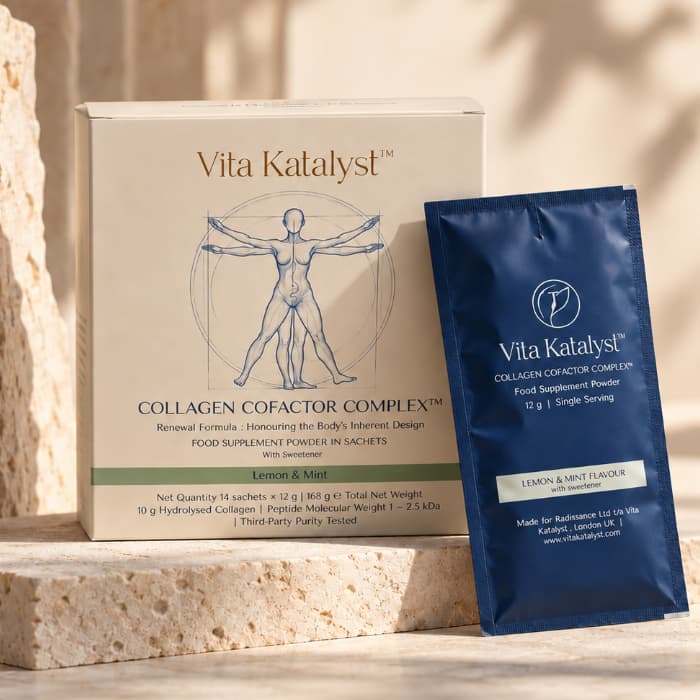

Join our community to receive a concise guide on collagen, skin structure and the science behind our formulation, plus evidence-led insights and updates.
No noise. You can unsubscribe at any time.

Collagen is a key structural protein in the skin, contributing to its strength, structure and flexibility. As we age, natural collagen levels decline, which can influence skin quality.
Vita Katalyst’s Collagen Cofactor Complex™ combines hydrolysed collagen peptides with selected nutritional cofactors as part of an evidence-led formulation.
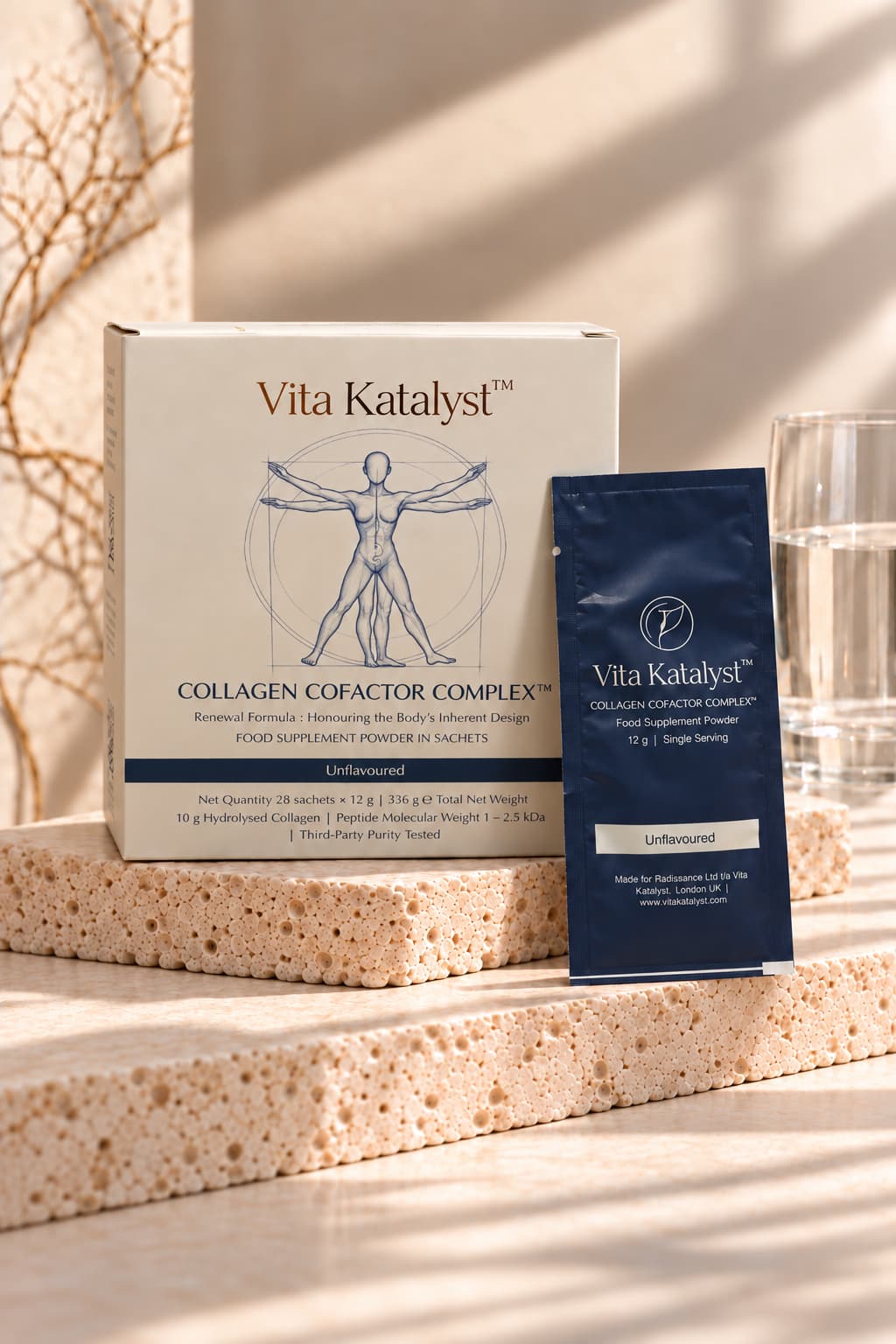
Join our community to receive a clear breakdown of the ingredients, their roles and the science behind our approach, plus evidence-led updates.
No noise. You can unsubscribe at any time.
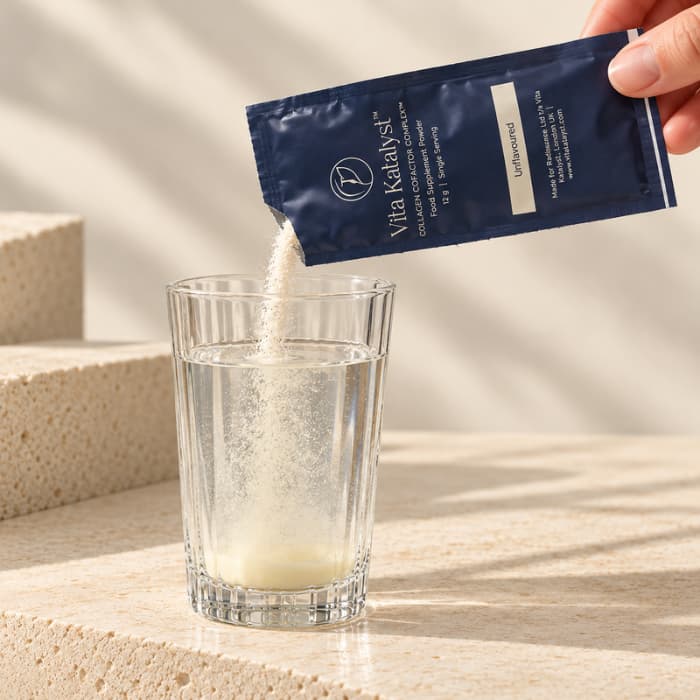
A considered collagen formulation is more than collagen peptides alone. It also looks at the nutritional factors involved in normal collagen formation and connective-tissue maintenance.
Collagen Cofactor Complex™ pairs collagen peptides with vitamin C, zinc, copper, silicon and biotin, each selected for a defined role within the wider formulation.

Nurture Aging™ begins with a simple premise: your biology is not a machine to hack, but a living system to support through the changes that come with time.
Our approach brings together evidence, deliberate formulation and respect for biological complexity, with a focus on the interconnected gut–skin–brain axis.
Discover what matters in collagen support, and the thinking behind our evidence-led formulation.