
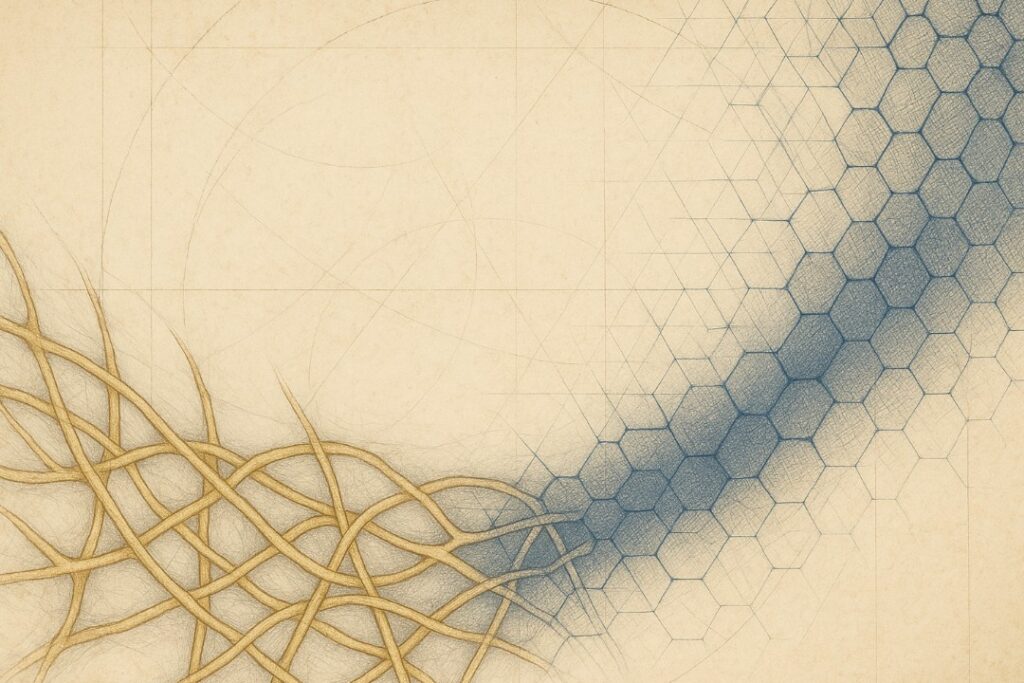

Collagen gives skin its tensile strength and elasticity—the hidden architecture beneath every expression. But collagen is vulnerable not only to the impact of sunlight. Inside the body, excess sugar can bind directly to these proteins in a process known as glycation. This reaction stiffens collagen, distorts its structure, and generates damaging by-products called advanced glycation end products (AGEs). Over years, these molecular cross-links accumulate, leaving skin less flexible, slower to repair, and more prone to visible signs such as wrinkles, loss of elasticity, and uneven skin tone.

What is Glycation? The “Sugar-Coating” of Collagen
Glycation is a slow, non-enzymatic reaction where sugar molecules attach themselves to proteins like collagen or elastin without the guidance of enzymes. This natural process occurs in the body as part of normal metabolism, where sugars react with proteins. Over time, these bonds produce advanced glycation end products (AGEs) — rigid molecular cross-links that gradually erode skin’s flexibility [Monnier et al., 2014].
Importantly, not every spoonful of sugar immediately damages collagen. In normal metabolism, glucose is tightly regulated, and early glycation products can sometimes be cleared or reversed. The problem arises when sugar levels spike repeatedly or remain elevated: more reactive sugars are left circulating, and the chance of these random, non-enzymatic reactions increases. Prolonged elevations happen when the body’s ability to handle sugar is strained — for instance, after repeated intake of refined starches or sweetened drinks, or when sleep loss and circadian disruption blunt insulin’s normal efficiency. Even long periods of sitting can worsen this post-meal rise, leaving sugar in circulation longer than the system was designed to manage.
Some sugars are more aggressive than others. Fructose, for example, is chemically more reactive than glucose, forming AGEs more quickly under experimental conditions [Wang et al., 2017]. Fructose is found naturally in fruit, but in that setting it comes diluted by water, slowed by fibre, and accompanied by polyphenols that act as built-in protectors. The greater concern is concentrated forms — fruit juices, syrups, or sucrose (a glucose–fructose pair) — where those natural buffers are stripped away and absorption is rapid.
Another key distinction is time. Early glycation products — temporary links between sugar and protein — can sometimes be undone. But if exposure continues, these adducts harden into irreversible AGEs. One in particular, glucosepane, accumulates heavily in aging collagen and is especially resistant to breakdown [Monnier et al., 2014]. In aged human skin and arteries, glucosepane accounts for over 90% of all crosslinks detected in collagen. Because collagen is a long-lived protein with slow turnover, once these cross-links form, they accumulate for decades.
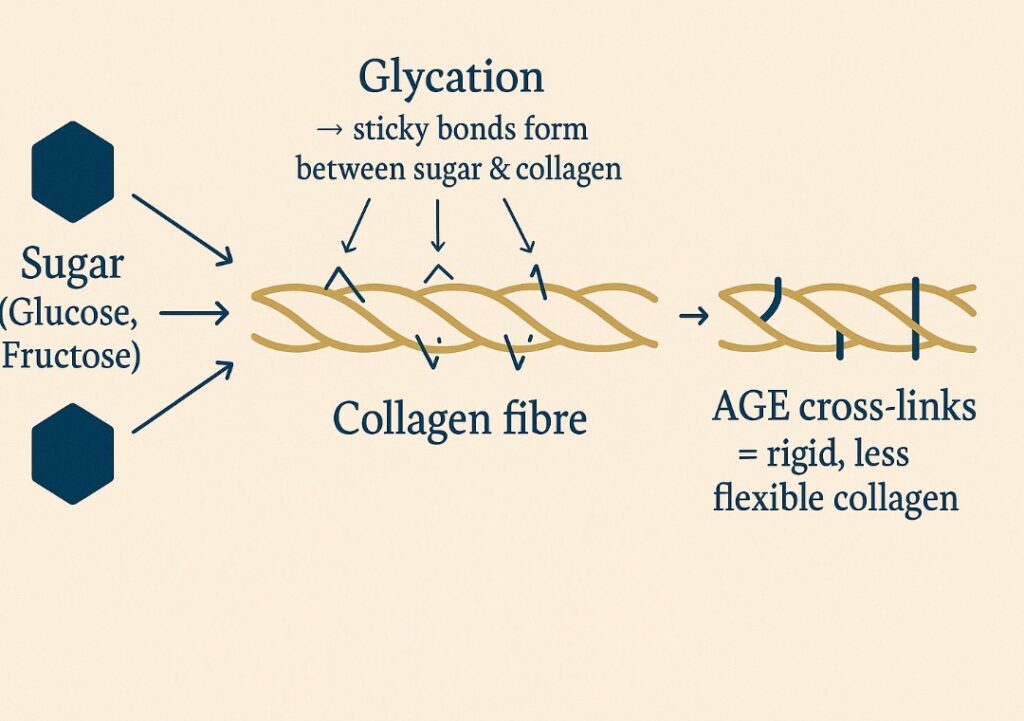
Glucosepane is like a superglue for collagen — once it sets, the fibres can’t move freely anymore. Other sugars may spark temporary mischief, but glucosepane is the one that permanently stiffens the fabric of skin. It has become a major target in anti-glycation and longevity research.
So far, no therapy has proven capable of breaking glucosepane in humans. What research does show is that supporting the body’s defence systems — glutathione-powered detox of reactive precursors, polyphenols and anthocyanins from plants, carnosine, and alpha-lipoic acid — can intercept the chemistry before these irreversible bonds set in. In other words: while the glue itself can’t yet be pulled apart, the drips of sugar that feed it can be cleaned up at the source. You can read more in our journal (The Science of Oral Antioxidants for Skin and Overall Vitality).
The Visible Impact: How AGEs Accelerate Skin Aging
When AGEs lock collagen fibres into stiff cross-links, the effects ripple outward from the microscopic to the visible. Collagen that once stretched and recoiled begins to fracture under pressure, while elastin loses its spring. Glycation leads to a decline in skin elasticity, making the skin less resilient and more prone to sagging. The skin that depends on these proteins for support gradually shows the consequences: fine lines deepen into wrinkles, firmness gives way to sagging, and the surface takes on a dull, uneven tone—changes characteristic of premature ageing caused by glycation.
Altering Texture and Elasticity
AGEs don’t just alter texture. They increase oxidative stress in the skin, which amplifies pigmentation irregularities, slows wound repair, and fuels redness or irritation that lingers. Over time, skin becomes not only less elastic but also less able to recover from daily stressors. [Wang et al., 2024].
Fuelling Inflammation via RAGEs
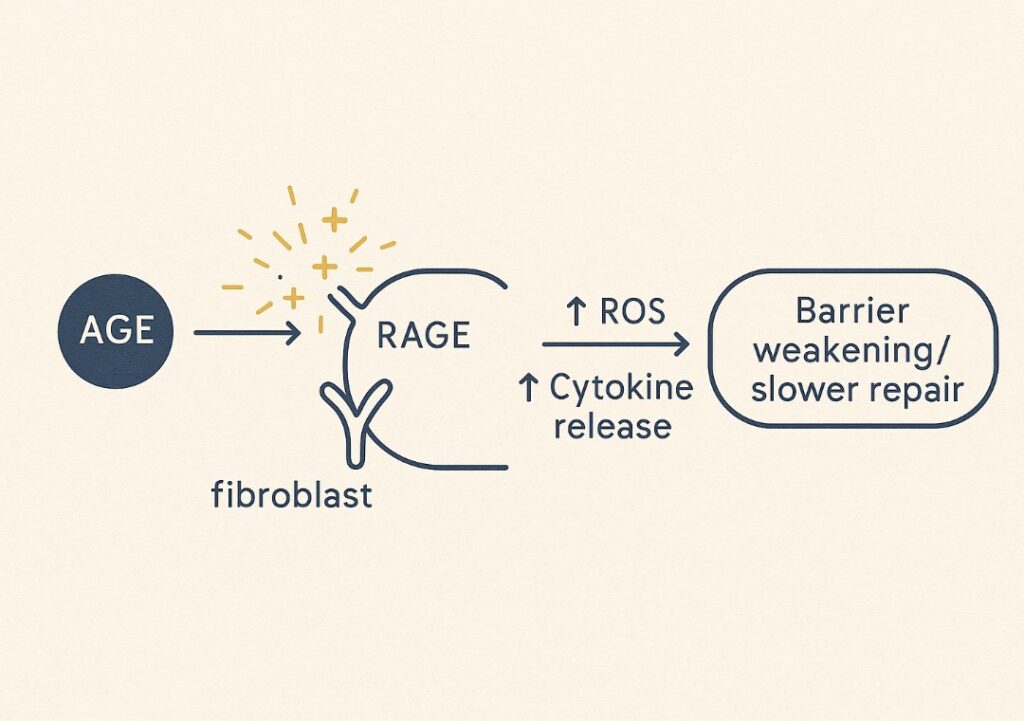
By binding to specific cell receptors, aptly named RAGEs, AGEs trigger a cycle of oxidative stress and inflammation, amplifying the damage beyond the collagen fibres themselves [Rungratanawanich et al., 2018]. Furthermore, RAGEs are present on immune cells, where their activation amplifies low-grade inflammation and blunts immune repair signals. This slows wound healing and weakens the skin barrier—effects visible as lingering redness, dry patches, or susceptibility to irritation. In this way, excess sugar doesn’t just stiffen the matrix; it undermines the very systems designed to defend and restore the skin.
The picture is compounded when AGEs and other accelerants overlap. Ultraviolet (UV) radiation, for instance, activates its own pathways of collagen breakdown, and together with glycation, creates a dual assault on the skin’s matrix. UVA exposure and dermal glycation together lead to increased oxidative stress in the skin. Where UV strikes from the outside, sugar weaves its changes from within.(For a full exploration of how sunlight contributes read our journal (Understanding UV, Collagen Breakdown & MMPs).
This cascade accelerates pigmentation irregularities, delays repair, and intensifies redness or irritation [Wang et al., 2024].
Protecting Your Collagen: Strategies for a Radiant Future
Collagen’s decline under glycation is not inevitable; biology offers counterbalances that can slow or redirect the process. Three areas stand out: how sugar is consumed, how antioxidant defences are supported, and how the skin’s structural blueprint is nourished.
Dietary Wisdom: Mindful Sugar Consumption
The pace of glycation depends heavily on glucose excursions — sharp rises in blood sugar after meals. Diets dominated by refined starches and sweetened drinks create large spikes that give sugars more time to attach to proteins, which accelerate glycation and contribute to premature skin aging. [Gkogkolou & Böhm, 2012]. In contrast, when sugars are embedded in fibre-rich foods like fruit or vegetables, absorption slows and polyphenols provide protective effects [Lee et al., 2021]. Even timing plays a role: disrupted sleep or late-night eating reduces insulin sensitivity, leaving sugar circulating longer [Chellappa et al., 2021].
Excessive consumption of high-AGE foods increases the risk of chronic diseases such as diabetes and cardiovascular disease. High AGE intake is also associated with a higher risk of insulin resistance and other chronic disease outcomes. To help lower AGE intake, it is recommended to include whole grains and a diet rich in fruits and vegetables. Reducing dietary AGEs offers overall health benefits, including improved metabolic health, reduced inflammation, and a lower risk of chronic diseases.
Whilst skin is often addressed as a cosmetic or beauty concern, modern biology reveals something deeper. The skin is a living reflection of internal physiology, where processes such as inflammation, cellular repair, and collagen turnover become visible at the surface. In this sense, skin acts as a biological window into the ageing process itself. Read more in our article on skin as a window into biological ageing.
Antioxidants: Your Internal Defence Against Glycation
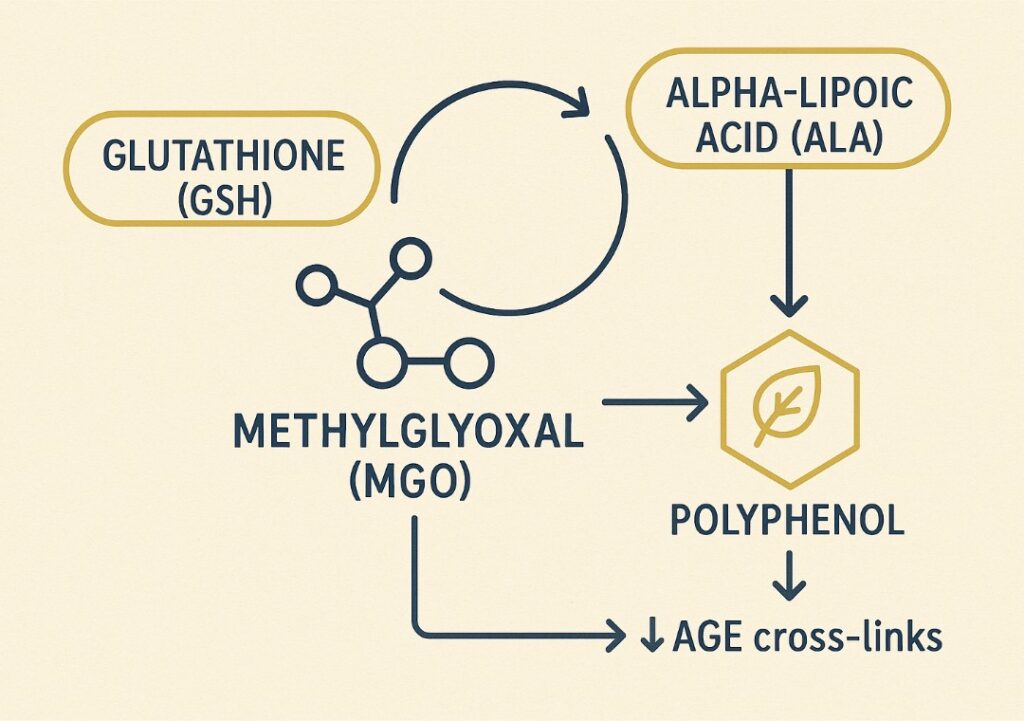
Beyond glucose control, antioxidant systems directly intercept the cascade. Glycation generates reactive intermediates such as methylglyoxal (MGO), which accelerates AGE formation. The enzyme glyoxalase I, powered by glutathione, detoxifies MGO before it can harden into cross-links [Yumnam et al., 2020]. When antioxidant reserves are strong, fewer of these reactive by-products linger to damage collagen.
Compounds like polyphenols, alpha-lipoic acid (ALA), and N-acetylcysteine (NAC) enhance this defence, either by neutralising reactive species or by recycling glutathione itself [Packer et al., 2001; Vašková et al., 2025]. These nutrients and plant extracts exhibit anti-glycation effects, supporting skin health by reducing AGE accumulation and preventing the formation of AGEs.
You can read more about the mechanism of ALA, Gluthatione and NAC, and their roles’ in protecting the Mitochondria and your Antioxidant defense system in (What Are Antioxidants? The Science of Oral Antioxidants for Skin and Overall Vitality).
Nurturing Your Skin’s Blueprint: Foundational Support
Collagen is not a passive victim; it is constantly being rebuilt. When the balance tips toward synthesis rather than degradation, skin retains its suppleness even in the face of glycation stress. Collagen play a major role in maintaining the skin’s structure and resilience. Providing the raw materials — like amino acids and peptides that stimulate fibroblasts, vitamin C as a cofactor for hydroxylation are essential for collagen production, and supports this renewal. [Wang et al., 2023]. Adequate intake of nutrients, including protein, vitamins, and minerals, is essential for collagen production and overall skin health. Collagen supplements may offer potential benefits for skin elasticity and wound healing. You can read more about in our journal (Do Collagen Supplements Work)
Cultivating Skin Vitality Through Balance
Glycation shows how everyday metabolic patterns leave a lasting imprint on skin. When sugars repeatedly bind to collagen, they harden the fibres that should give skin its flexibility, while fuelling inflammation that weakens its repair systems. Over years, these changes accumulate, leaving visible traces well beyond what chronological ageing alone would dictate. The accumulation of AGEs is not merely a cosmetic concern; it is implicated in the pathology of age-related systemic diseases, highlighting the deep connection between skin health and overall longevity.
Yet biology is not passive. The same systems that create damage—glucose handling, antioxidant defences, collagen renewal—also hold the tools to slow it. Supporting those systems through diet diversity, antioxidant strength, and lifestyle balance helps preserve collagen’s adaptability and the skin’s overall resilience. In this light, skin vitality is less about resisting age and more about working with the body’s chemistry intelligently. By understanding processes like glycation, we can make choices that allow the skin to age in a way that reflects health rather than acceleration.
Be first to try our evidence-built formulations.
Collagen Cofactor Complex + Cellular Triad Glutathione Complex.
No noise. No guesswork. Just biologically honest design.